Saturday, April 29, 2017

The Norway Maple

The Norway Maple (Acer platanoides) is one of the earliest trees to flower in the NE. It's clusters of chartreuse flowers signals the beginning of spring. Introduced to the US in 1756, it quickly became a popular street tree for its ability to tolerate adverse conditions. On the other hand, the native Sugar Maple is famously (among gardeners) unable to tolerate disturbance to roots, heat, and drought, associated with life in urban areas. Many other native trees like the American Elm, Ash, and American Chestnut were killed by diseases hitchhiking over on plant from Europe. To replace the rapidly dying canopy, trees like the Norway Maple were planted. The Norway Maple made itself at home in the NE and quickly began to spread outside of gardens and cities. However, at the time, much of the land was being farmed so its opportunity to invade forests was lessened because there were no forests to invade.
Norway Maple flowers
 Plains and elsewhere, Farmland was abandoned en masse and allowed to revert back to forest. In the past, Eastern Hemlock (Tsuga canadensis), Sugar Maple (Acer saccharum), and Red Oaks (Quercus rubra) would be the dominant species in a climax forest. However, the Norway Maple had many advantages. For example, its root system is thick and fibrous, allowing it to literally suck the life out of the soil, as anyone who has tried to grow a lawn under one of these trees can attest. In addition, any plants that managed to grab a foothold under the tree would be shaded out by the Norway maple's wide leaves. The fact that it is one of the earliest trees to leaf out also helps. Its ability to out compete many trees also allows it to suppress the understory. There is simply not much that can grow under a Norway maple. Interestingly, to me these characteristics would be a dealbreaker for an ornamental tree not to mention that it often girdles itself in cramped environments, that it, strangle itself to death with its roots, but I guess some people want a carefree tree.
 
Norway maples often establish pure stands, especially near areas disturbed by humans. In the more far flung areas, there are isolated specimens, but something has kept them from establishing themselves. Either they physically did not spread there or they may have already died out since their lifespans generally under 100 years as the secondary growth forest grows. Either way, it is considered an invasive species for its ability to displace native plants in disturbed sites.

I don't have anything against introduced species coexisting with native species but as some of the introduced species, like Norway Maples push other plants out, then they become a problem. Even in their native habitat, they do not form monocultures since there are diseases and other plants that keep them in check, which are not present in the US. These species should be dealt with accordingly, ideally by extirpation. However,  the attitudinal fix of education probably won't work, especially when the tree is mainly planted in urban areas where people can't see its effects. A technical fix would be creating a sterile variety that can;t reproduce. But there are certainly breeding populations out there already and those would need to be eliminated. The structural fix of banning the sale of them, which has been done in some states like Wisconsin and Illinois, where the invasion has been worse, but the sale of the Norway Maple in New York is still legal and only regulated in a way that intentional introduction into the wild is illegal. The Norway Maple is probably one of the oldest invasive species in the US, and like almost all the other ones, was introduced as a ornamental or agricultural plant with an intended use. The list of problems the cause goes on and on. It also goes to show that some actions intended to fix problems can create more problems than they are worth.

Sunday, April 16, 2017

I like trees Part II

Wow I really ran off on a tangent over there on the last post. As humans, we seem to appreciate things that are bigger and older than us, like trees. They have seen and been through more than any of us, and yet they stand there unmovingly, silent. Something about their branches upstretched towards the sky. They are the epitome of the religious sublime and just enduring grandeur in general.  I really do love trees and I am saddened by their destruction by disease, as well as by human activity. Growing up in a neighborhood undergoing redevelopment in a rapidly developing suburb of DC, I have seen more than my fair share of trees, often older than the houses they stand by go down and be replaced by new McMansions or entire forests be replaced by a new subdivision. It seems that in the buzz of growth and prosperity, we have forgotten what literally constructs the country-trees.  Sometimes us treehuggers secure a victory, such as when urban planners decided to build metro tracks to curve around the oldest tree in my county at an estimated 299 years old. Even then, it's bounded by a 6 lane road on one side, and a freeway on another and if it wasn't the oldest tree, it would have been ground to mulch.
The Linden Oak, a White Oak, with the metro tracks in the background

In comparison, the oldest tree on campus here at Cornell is also an White Oak, with an estimated age of 350 years old. It is located on Libe slope near Gannet.
Image may contain: tree, sky, snow, plant, house, outdoor and nature
Cornell's oldest tree
In the arboretums, I saw this oak, a Red Oak, which is actually much larger than the Libe Slope oak. However, I could not find any information on the age of the tree or the circumstances of its existence. I have observed trees from all walks of life so I could probably make a guess. Based on its low branching, it probably grew in a full sun and exposed environment. The tree didn't have to grow upwards and compete for light as it would in a forest. It's also meant it had no use as lumber. It was also probably spared the fate of being plowed over since it grew at the transition between a flat area useful for farming into a rather steep hill. The area to the left is still being used as research fields today. As the trees grew in around it, the oak was forced to reach up for the light again, which is why many of the horizontal branches abruptly turn upwards. These limbs died back to a limb that had access to the sun. The wounds from these large dead branches will probably be the downfall of the tree though, as rot progresses down the branches and hollows out the trunk, the horizontal branches might overload, leading to collapse. Cornell seems to see the tree as a risk, which is why it is roped off. It's also pretty good for the tree if we don't tread on its rootzone.


I wouldn't be surprised if this majestic oak has been here for longer than Cornell has been around. Let's see, 1865 founding... 152 years... So if that tree is older than 150 years than it's older than Cornell. Maybe, but without a core we will never find out. Or maybe we don;t hear about it because it's not the oldest or the biggest (also on Libe Slope). It's a shame that people often only care about the superlatives. The way I see it, a 100 year old oak still deserves respect. Don't kill it by stupidly digging a trench 15 feet from the trunk for a septic line. Even a sapling is something precious. The majority of seeds produced don't even get to sprout. We should share the land with the trees that inhabit it. They hold memories of the past (in the rings and branches) and are inn fact living things. In any case, this majestic tree that is lucky to not be located in any land desirable for development (like that poor Fernow oak).  May it have many years of life ahead.


Saturday, April 15, 2017

I like trees

Today I wandered into another part of campus I've been meaning to go to since I got here but never found the time to. I went to the F.R. Newman Arboretum. An arboretum is a collection of trees only, although generally the have woody shrubs and underplantings of herbaceous plants. Many arboretums were created as a way to display trees and shrubs that grow in the climate and region the arboretum is located. I have liked trees for as long as I can remember. The first picture I drew was a tree and even though I like plants in general, I love trees above all. The arboretum is where I am at home.

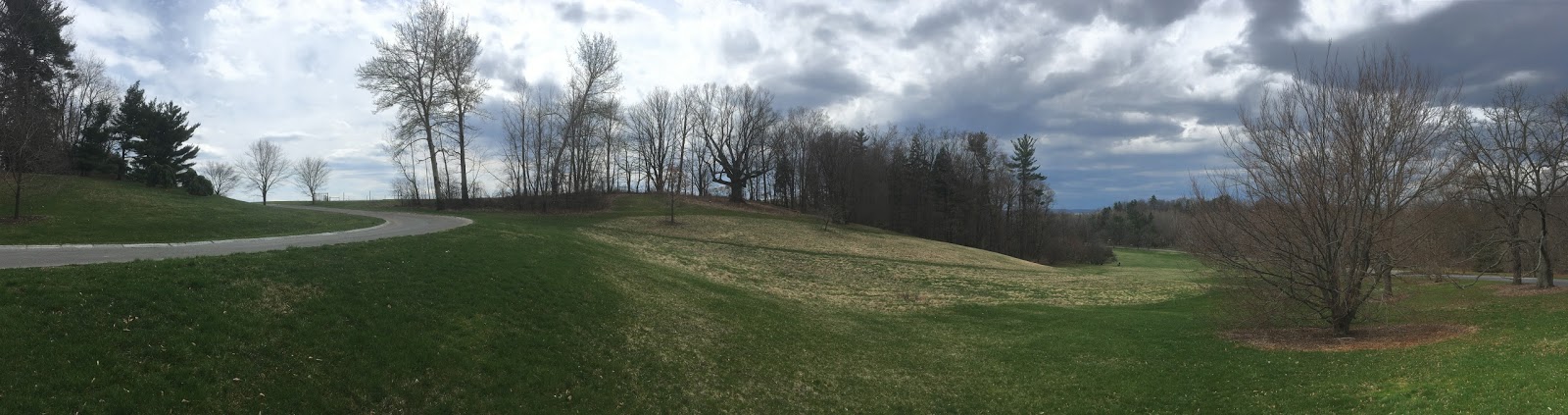
Seems like a lot of grass. Room for expansion.
I wandered through the grove of nut trees by Fall Creek (Another place I want to go through). The road followed a ridge  where on the left was the wooded valley leading into Fall Creek and on the right were the managed plantings of the arboretum. The woods are probably second growth forest from when the area was logged, based on the fact that the slope is probably too steep for farming. The area has an canopy of Sugar Maple, Oak, and American Beech, with an understory of young hemlocks, which will one day make up the climax forest given enough time.

Woodland vs managed plantings
But these forests will never be the same as before we logged them. The entire ecological system is different and is still changing. Generally, we tend to focus on the negatives with the assumption that the past what is desired. With environmental restoration, we strive for the pure and untouched ecosystem that predates human settlement. We call unlogged forests "virgin" growth. Hoewever even these tracts have been changed, probably irreversibly. Introduced species and diseases are changing the forests. Not that they haven't been for hundreds of years.


On the left of the previous photo, one can see a tree with bright gray bark. This is the venerable American Beech, one of the dominant trees of NE forests. It probably won't remain so for very long. Around 1890, the insect, beech scale was introduced to Nova Scotia. The beech scale sucks the sap of beech trees and the wounds are a open path for a fungi Nectria coccinea var. faginata to enter and infect the tree. In an effort to stop the infection, the tree kills off tissue surrounding the infection site, causing sunken cankers in the bark. Since there are many infection sites, the cankers cut off nutrient and energy flow between the leaves and the roots and the top of the tree dies. By 1932, the disease had spread into Maine and since then it has continued its slow march south,. The infection front is currently in Pennsylvania. Many of the beeches in the Ithaca area show signs of of infection, and this one is no exception. The normally smooth bark is pockmarked by cankers. Tree mortality stands at 30-50%, with many of the survivors being damaged and susceptible to other stressors. Unfortunately, there is no treatment for either the fungus or scale. Trees that are infected can also regenerate from root sprouts although these are quickly infected too and do not gain much size.

To add insult to injury, someone has carved things into this specific tree. Beeches are favored for "X was here" carvings due to their smooth bark. In the past, this may have had been simply a cosmetic injury to the tree, but since the beech scale finds shelter in these rough cuts, this makes the trees more susceptible to the disease. Sadly, either way, this tree was probably going to go out someday. The bright side is that there are resistant trees that seem to be able to prevent scale infestation and therefore the fungus invasion. Although it may seem counterproductive, it is recommended to kill any infected trees that resprout. This would allow the resistant trees to proliferate and decrease reservoirs for disease. It is my hope that we will be able to develop resistant varieties of not just beeches, but also other trees that once populated our forests that have been killed off by disease. I would also love to be able to contribute to the effort as a plant scientist.